

Knowing what drives product photography pricing means you can budget accurately, scope projects without surprises, and make smarter decisions. Product image costs vary based on shoot complexity, retouching requirements, service model, and a handful of other variables that aren't always obvious upfront.
In 2026, new technologies and service models have changed how studios structure their rates. Understanding the logic behind the numbers puts you in a better position before you ever request a quote.
The Foundation: Core Product Image Cost Factors
When evaluating photography quotes, a few fundamental variables set the baseline price. Product complexity is the primary driver. A white background shot of a water bottle requires significantly less setup than a lifestyle scene with multiple props and models.
The most common cost factors:
- Product size and weight, which affect shipping, handling, and storage
- Surface characteristics, including reflective, transparent, and textured materials
- Number of angles and variations needed per product
- Background requirements, whether white, lifestyle, or contextual
- Post-production and retouching depth
Studios offering specialized e-commerce product photography tier their pricing around these complexity levels. Flat lay arrangements require different expertise than capturing intricate jewelry details or managing reflections on electronics. The work isn't the same, and the pricing reflects that.


Volume matters too. Shooting 10 products costs more per image than photographing 500, because setup, lighting, and workflow optimization become more efficient at scale. Per-image pricing models explain how volume discounts work across different studio structures.
Equipment and Studio Overhead
Behind every product image is substantial infrastructure. Professional studios run expensive camera systems, specialized lenses, lighting rigs, backdrops, and shooting surfaces that collectively represent significant capital investment.
Studio space adds another layer of fixed cost. Climate-controlled environments with proper electrical capacity, adequate square footage for various set sizes, and professional-grade facilities are expensive to maintain, particularly in major markets. The cost considerations of running an in-house photo studio make a strong case for why professional services often deliver better value than building internal capabilities.
Equipment depreciation and maintenance are real costs that reputable studios build into their pricing. Cameras need regular sensor cleaning, lenses require calibration, and lighting equipment eventually needs replacing. That overhead doesn't disappear; it just gets factored in honestly.
Photography Style and Complexity Variations
Not all product images serve the same purpose, and cost shifts significantly based on what you're actually trying to achieve.
Catalog Photography
Catalog shots, clean white background images that show products clearly and accurately, are the most economical option. They prioritize consistency and speed, allowing photographers to capture dozens or hundreds of products per day.
.jpg)
Even within catalog photography, specifications vary. Amazon's product image requirements differ from other platforms in ways that affect production time and add complexity to what looks like a straightforward shoot.
Lifestyle and Creative Photography
Lifestyle photography is a different cost equation entirely. These shoots require concept development, location scouting or set building, prop sourcing, and often talent coordination. Creative product styling demands artistic vision and significantly more production time than catalog work.
A lifestyle shoot typically involves:
- Pre-production planning and mood board creation
- Location scouting or studio set design
- Prop acquisition and arrangement
- Model casting and direction
- Extended post-production and compositing
The gap between a $25 catalog shot and a $500 lifestyle image comes down to those expanded production requirements. Understanding photography pricing models clarifies why creative work commands premium rates and what you're actually paying for when you commission it.
Retouching and Post-Production Depth
Post-production is where most businesses underestimate their costs. The shoot captures the raw material. Retouching is what turns it into a finished marketing asset.
Basic retouching covers:
- Color correction and white balance adjustment
- Background cleanup and standardization
- Minor dust and scratch removal
- File formatting and optimization
Advanced retouching involves:
- Detailed object refinement and edge work
- Perspective correction and alignment
- Shadow and reflection creation or enhancement
- Composite image assembly from multiple shots
- Extensive surface perfection and blemish removal
Close-up product photography makes retouching especially critical. Magnified details expose every imperfection, and pixel-level work is labor-intensive. Comprehensive retouching can double or triple the base photography cost, and that's not padding — it's the actual time required to do it properly.
For specialized categories like jewelry, retouching carries even more weight. Metals need proper highlights, gemstones require sparkle enhancement, and fine details demand a level of precision that only experienced retouchers can deliver consistently at volume.
Time Investment in Post-Production
Editing timelines vary considerably. A straightforward catalog image might take 5-10 minutes. An intricate lifestyle composite can take several hours. Before accepting any quote, ask exactly what's included in base retouching and what triggers additional fees. That line is where budgets most often go sideways.
Location and Market Influences
Geography has a direct impact on photography pricing. Studios in New York, Los Angeles, and San Francisco typically charge 30-50% more than those in smaller markets, reflecting higher rent, labor costs, and operating overhead.
That said, major markets offer real advantages beyond the price tag:
- Access to specialized talent and stylists
- Broader prop and rental equipment availability
- Proximity to major brands and fashion districts
- Stronger networks within the industry
Product photography services across different cities show how market variations play out in practice, while studios with standardized workflows maintain consistent quality regardless of location.
Remote photography has become a practical alternative for many brands. Shipping products to a studio in a more affordable market can generate meaningful savings on hourly rates without sacrificing output quality. The tradeoff is logistical: shipping timelines, product packaging requirements, and the inability to be on set need to factor into the decision. For straightforward catalog work, it often makes sense. For complex creative shoots requiring real-time direction, proximity still has value.
Team Size and Expertise Requirements
Complex shoots require multiple professionals, and team composition directly affects cost. A solo photographer handles simple catalog work efficiently. Elaborate productions need coordinated specialists.
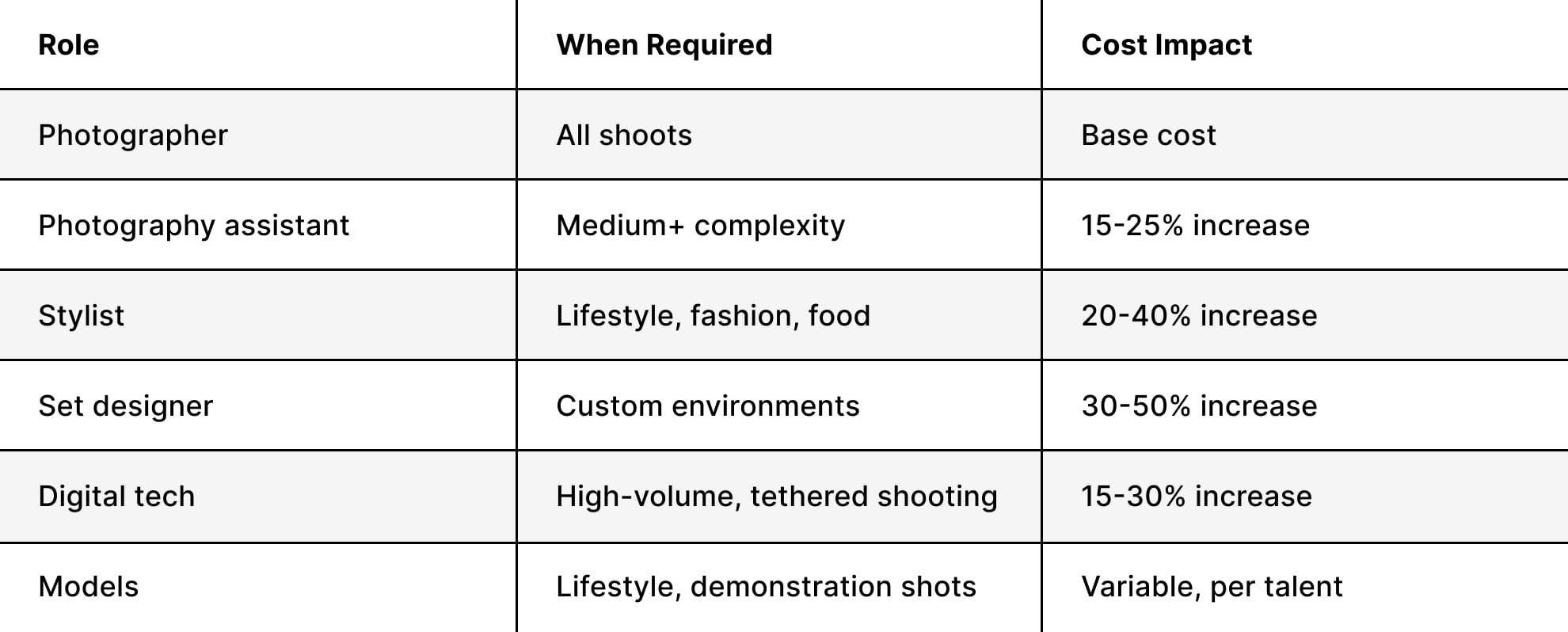
Larger teams complete complex shoots faster and typically deliver stronger creative results. The cost increase is real, but so is the output quality. Solo photographers offer lower rates; they also have a ceiling on what they can execute well.
Photographer specialization matters too. A generalist might charge $75-150 per hour. Specialists in demanding categories like beauty product photography command $200-400 per hour, and for technically challenging work, that expertise gap shows up directly in the final images.
Turnaround Time and Rush Fees
Standard delivery runs 5-14 business days. Expedited service costs more because studios are reallocating resources, extending hours, or bumping scheduled work to accommodate the timeline.
Typical rush fee structures:
- 24-48 hour delivery: 50-100% surcharge
- 3-5 business day delivery: 25-50% surcharge
- Weekend or holiday shoots: 50-150% surcharge
- Same-day editing: 100-200% surcharge on post-production
For time-sensitive launches or campaign deadlines, paying the premium is often justified. But it's an avoidable cost. Building realistic buffer time into your production schedule is one of the simplest ways to reduce photography spend without changing anything else about the shoot.
Volume Discounts and Package Pricing
Studios structure pricing to reward larger orders, making volume one of the most controllable cost factors in product photography. Knowing where the break points are helps you optimize the budget without changing the scope of work.
Typical volume tiers:
- 1-10 images: Full per-image rate ($50-150 each)
- 11-50 images: 10-15% discount per image
- 51-100 images: 20-25% discount per image
- 100+ images: 30-40% discount per image, custom negotiation
Pricing guidance for bulk orders explains the economics behind these tiers. Setup costs spread across more units, lighting stays consistent, and workflow efficiency improves at scale. Batching products into fewer, larger shoots is one of the most straightforward ways to reduce cost per image.
Some studios offer subscription models where brands pay monthly retainers for ongoing photography needs. For companies with regular product launches, these arrangements provide predictable costs and priority scheduling. Online communities like Talk Shop regularly surface how e-commerce merchants evaluate these long-term structures.
Package Bundling Strategies
Bundling services locks in volume commitments while building out a more complete visual asset library. A typical studio might offer:
- Standard: White background, catalog images only
- Enhanced: Catalog images plus one lifestyle shot per product
- Premium: Catalog, lifestyle, and detail shots with advanced retouching
- Campaign: Full creative direction, multiple concepts, and usage rights included
Bundling works because it forces the planning conversation upfront. When you know exactly what you need across multiple types of e-commerce images, you can structure the engagement to cover all of them at a better blended rate than commissioning each type separately.
Usage Rights and Licensing
Intellectual property considerations represent frequently overlooked product image cost factors. Photography ownership and usage rights significantly impact both immediate costs and long-term value.
Common licensing structures include:
- Full buyout: Client owns all images and unlimited usage rights (typically 20-50% premium)
- Standard commercial license: Unlimited use for the client's own marketing (base price)
- Limited license: Specific channels, duration, or geographic restrictions (sometimes discounted)
- Exclusive rights: Photographer won't shoot competitors (premium pricing)
For brands building long-term visual libraries, investing in full buyouts makes sense despite higher upfront costs. However, startups and smaller businesses might negotiate limited licenses initially, expanding rights as budgets grow.
Model releases and property permissions add complexity and expense to lifestyle shoots. When talent appears in images or recognizable private locations feature prominently, proper legal documentation becomes mandatory, and photographers typically charge coordination fees for handling these requirements.
Technology and AI Impact on Pricing
AI has changed the cost structure of product imagery, but not in a straightforward direction. AI tools for product photos have made background removal, basic retouching, and virtual scene creation faster and cheaper. For simple catalog work, recent analysis of product photography costs suggests AI has pushed pricing down 15-25%.
At the same time, AI has raised quality expectations and made more ambitious creative work achievable at scale. The net effect isn't simply lower prices across the board — it's a more segmented market where commodity work gets cheaper and premium creative commands more.
Professional studios now integrate AI into their workflows, passing efficiency savings on to clients while maintaining human oversight for quality control and creative direction. The question of whether brands should use AI product images doesn't have a universal answer. It depends on the application, the brand's positioning, and what the image actually needs to do.
Hybrid Approaches
The most effective studios use AI for what it does efficiently and human expertise for what it does better. In practice, that means:
- AI handles initial background removal and basic cleanup
- Professional judgment drives lighting and composition decisions
- Skilled retouching is reserved for hero shots and campaign images
- File preparation and format optimization run on automation
The result is a leaner cost structure without sacrificing quality, where quality actually matters.
Category-Specific Cost Considerations
Every product category has its own technical challenges. Knowing what drives complexity in your category helps you set realistic budgets before you request a single quote.
Apparel and Fashion Photography
Clothing photography breaks down into three main approaches: ghost mannequin, model shoots, and flat lay, each with a distinct cost profile. Ghost mannequin requires specialized equipment and post-production work to create the invisible-form effect. Model photography adds talent fees, styling costs, and often location expenses on top. Flat lay is the most economical but has limitations for showing fit and drape.
Fabric texture adds another layer of complexity. Reflective satins, matte cotton, and textured wool each require different lighting approaches to represent material quality accurately. Creative composition techniques help fashion brands differentiate visually while keeping production efficient.
Jewelry and Small Valuables
Precious items introduce costs that go beyond the shoot itself. Macro photography, focus stacking across multiple exposures to achieve full depth of field, and meticulous retouching of metal reflections and gemstone brilliance all add time. Security considerations during transport and on set, along with insurance and careful handling protocols, add operational overhead that studios factor into their pricing.
The investment is justified. Jewelry imagery that accurately renders brilliance and detail converts at a meaningfully higher rate than photography that doesn't.
Food and Beverage
Perishable products create time pressure and waste costs that don't exist in other categories. Food styling requires specialized skills, ingredient budgets, and often multiple backup versions of dishes as heat and lighting degrade them during the shoot. Condensation management in beverage photography requires climate control and a fast turnaround between setups.
Most food productions require a dedicated food stylist at $200-500 per day, plus grocery and prop budgets on top. It's one of the more expensive categories to shoot well, but the impact of quality food photography on purchase intent makes the investment hard to argue against.
Hidden Costs and Budget Surprises
Even with a detailed quote, unexpected costs can surface mid-project. Knowing where they typically come from helps you scope projects more accurately upfront.
Common additions that catch brands off guard:
- Product damage during shipping, leading to insurance claims and delays
- Additional angles requested during the shoot review
- Extended retouching for unforeseen product imperfections
- Rush delivery needs due to schedule changes
- Model reshoots when lifestyle images miss the brief
- Props and styling elements outside the original scope
The most effective protection is a thorough brief. Detailed shot lists, reference images, and clearly defined technical specifications reduce the gap between what you expected and what you receive. E-commerce image standards give you a useful framework for defining those specs before the shoot begins.
Evaluating Value Beyond Price Alone
The lowest quote rarely delivers the best outcome. When comparing options, evaluate total value rather than cost per image in isolation.
Quality indicators worth assessing:
- Portfolio depth in your specific product category
- Client testimonials and repeat business rates
- Turnaround reliability and on-time delivery history
- Retouching quality and attention to detail
- Communication responsiveness and problem-solving ability
- Technical capabilities for your specific needs
A photographer charging $100 per image who consistently delivers strong work, meets deadlines, and requires minimal revision creates more value than a $50 provider whose output needs extensive corrections or arrives late. Pricing breakdowns across the industry show that mid-range pricing often reflects experienced professionals who've built efficient, high-quality processes rather than those cutting corners to compete on rate.
For brands building long-term visual identity, the relationship itself has value. A studio that understands your aesthetic, knows your products, and anticipates your needs reduces friction on every project. That institutional knowledge compounds over time, producing better results and fewer revisions than starting fresh with a new vendor every quarter.
DIY Versus Professional Services
In-house photography looks like a cost-saving move until you account for everything it actually requires. Beyond the obvious camera and lighting purchases, the real costs include:
- Learning curve and time investment, which carries a real opportunity cost
- Software subscriptions for editing and asset management
- Ongoing equipment maintenance and upgrades
- Physical space dedicated to photography
- Inconsistent results that require reshoots, wasting both product and time
Comprehensive cost analysis puts the break-even point for in-house studios at roughly 200-300 images per month. Below that threshold, professional services almost always deliver better value. Above it, specialized shoots frequently still warrant external expertise regardless of volume.
That said, simple product documentation or internal catalog needs can justify basic in-house capabilities. The honest assessment comes down to three questions: what quality standard do your images actually need to meet, what volume are you shooting consistently, and what resources are genuinely available to support it. Answer those before committing to equipment that may sit underused or underperform against expectations.
Negotiating and Optimizing Your Photography Budget
The most effective way to reduce photography costs isn't aggressive price negotiation. It's smarter planning that creates efficiency for both sides.
Strategies that actually work:
- Batch shooting: Combine multiple product launches into a single large shoot to spread setup costs across more units
- Flexible scheduling: Book during slower seasons for better rates without compromising on quality
- Long-term commitments: Negotiate annual contracts with volume guarantees for predictable pricing on both sides
- Tiered approach: Invest in hero shots, use simpler production for supporting images
- Clear specifications: Reduce revision rounds through comprehensive briefs before the shoot begins
Many studios offer off-peak discounts during traditionally slow periods, typically January through March and late summer. Filling calendar gaps works in both directions: the studio gets predictable work, and you get better rates.
When negotiating, focus on value additions rather than straight discounts. Ask about package upgrades, additional deliverables, or extended usage rights instead of pushing for lower per-image rates. Studios maintain healthier margins, the relationship stays collaborative, and you often walk away with more than a simple price reduction would have delivered.
Platform-Specific Requirements
Different sales channels have different technical standards, and those standards affect how you plan and budget a shoot. Optimizing your Amazon product listings requires specifications that may differ significantly from what your Shopify store or Instagram feed needs.
Amazon requires:
- Minimum 1,000 pixels on the longest side, ideally 2,000+ for zoom functionality
- Pure white background (RGB 255, 255, 255) for main images
- Product filling 85% of the frame
- No logos, text, or graphics on the main image
Instagram prioritizes:
- Square (1:1) or vertical (4:5) format
- Lifestyle and contextual imagery over clinical product shots
- Authentic, mobile-optimized composition
Essential product image display tips show how different platforms consume images and why production planning needs to account for all of them from the start. Capturing platform-specific variations during the original shoot costs a fraction of what a reshoot does later. Tell your photographer which channels you're shooting for upfront so they can capture the right angles, formats, and variations in a single session.
Understanding what drives product photography pricing puts you in a better position to budget accurately, evaluate providers fairly, and get more from every shoot. The right investment level varies by product category, business stage, and what your images actually need to accomplish.
Whether you need efficient catalog photography or full creative campaign production, Squareshot delivers consistent quality and reliable turnaround built around your specific requirements.
Product A
SQUARE SHOT