

Your brand's visual identity lives (or dies) by consistency.
Every product image you publish contributes to how customers perceive your brand, whether you're launching a new skincare line or selling handcrafted furniture. A product photography style guide serves as your roadmap to maintaining that consistency across every channel, from your e-commerce site to social media platforms.
Without documented standards, your brand identity becomes fragmented, confusing potential customers and weakening your brand photography.
Why Your Brand Needs a Product Photography Style Guide
Think about the last time you scrolled through an online store where some photos had white backgrounds, others featured colorful scenes, and a few looked like they were shot in someone's garage. That inconsistency creates doubt. Customers subconsciously question whether they're buying from a professional operation or a fly-by-night seller.
A well-crafted product photography style guide eliminates this problem entirely. It ensures that whether you're shooting jewelry in January or apparel in July, the product images maintain the same visual language. This consistency builds trust, reinforces brand recognition, and makes your products instantly identifiable.
The business benefits extend beyond aesthetics:
- Faster production turnaround when photographers know exactly what to deliver
- Reduced revision requests and reshoot costs
- Easier onboarding for new team members or external photographers
- Consistent customer experience across all touchpoints
- Stronger brand positioning against competitors
When you develop a comprehensive photography style guide, you're investing in long-term brand equity. The upfront effort pays dividends every time you launch a new product or expand into new channels.
Core Components of Your Product Photography Style Guide
Creating a product photography style guide means documenting every visual decision that affects your brand's appearance. Let's break down the essential elements that transform scattered product images into a cohesive visual system.
Background Choices and Consistency
Your background selection dramatically impacts product perception. Most e-commerce brands start with white backgrounds because they work everywhere, from Amazon product listings to your own website. But your style guide should specify exact standards.
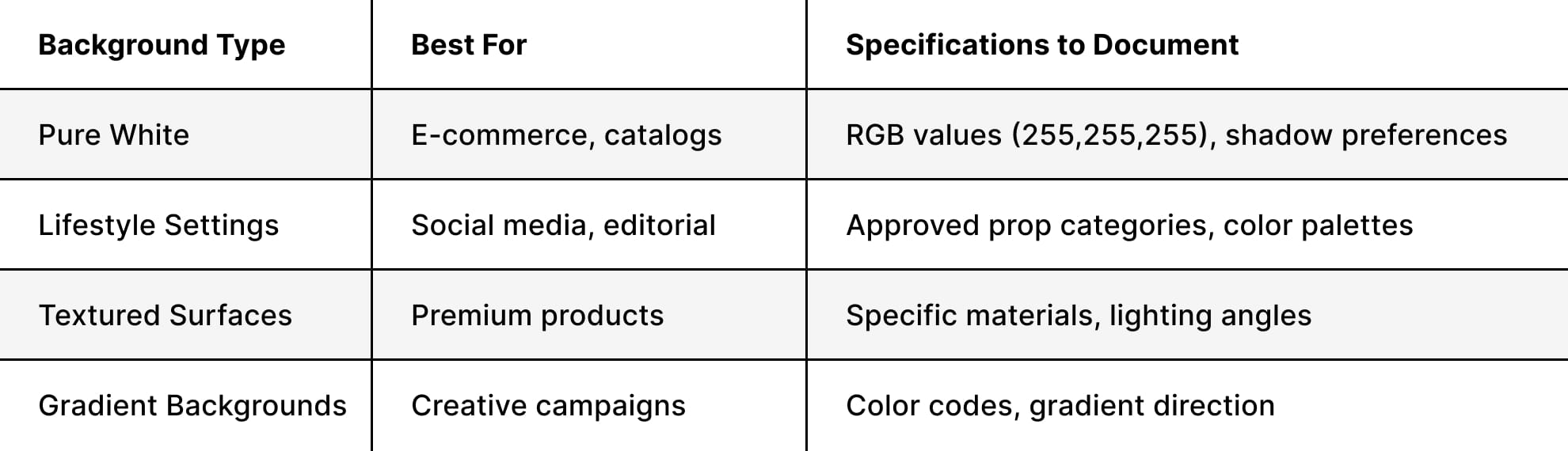
The key is to document not just what backgrounds you use, but also when and why. Your white background studio approach might be perfect for product detail pages, while lifestyle shots work better for Instagram.


Lighting Setup and Mood
Lighting creates mood, reveals texture, and influences purchasing decisions. Your product photography style guide should specify artificial lighting setups with enough detail for any photographer to recreate your signature look.
Document these lighting elements:
- Primary light position (degrees from subject, height, distance)
- Fill light ratios (specific power settings or relative brightness)
- Backlight or rim light usage (when to use, intensity levels)
- Shadow softness or hardness (modifier types, diffusion techniques)
- Color temperature standards (exact Kelvin values)
For consistency, many brands establish specific lighting patterns for different product categories. Jewelry might require a harder light to showcase sparkle, while skincare products benefit from soft, diffused lighting that conveys gentleness.
Composition and Framing Rules
How you position products within the frame affects everything from perceived value to conversion rates. A product photography style guide needs specific composition rules that photographers can follow shot after shot.
Standard composition specifications include:
- Product placement within frame (centered, rule of thirds, specific margins)
- Product size consistency (percentage of frame, measuring points)
- Angle specifications (straight-on, 45-degree, three-quarter view)
- Orientation requirements (portrait vs. landscape by product type)
- Negative space allocation (minimum clearance around products)
When shooting clothing versus shoes, your composition rules will differ significantly. Document these variations clearly so photographers understand the reasoning behind each standard.
Color Palette and Post-Processing Standards
Colors trigger emotional responses and brand recognition. Your product photography style guide must establish color standards that extend from shooting through final delivery.
Define your color approach across these areas:
- Background color values (RGB, CMYK, Hex codes)
- Acceptable prop colors by season or campaign
- Product color accuracy requirements
- White balance targets during shooting
- Post-processing color grading preferences
The retouching phase is where color standards get enforced most strictly. Specify exactly how much adjustment is acceptable and what the final image should convey. Some brands maintain detailed photo style guides that include before-and-after examples showing acceptable color correction ranges.
Building Your Product Photography Style Guide Step-by-Step
Creating a comprehensive product photography style guide doesn't happen overnight. It's an iterative process that evolves with your brand while maintaining core consistency.
Step 1: Audit Your Existing Photography
Start by examining every product image currently representing your brand. Spread them across a large monitor or print them out. You'll quickly spot inconsistencies that confuse your message.
Look for variations in:
- Background colors and treatments
- Lighting quality and direction
- Product positioning and sizing
- Image resolution and sharpness
- Color tones and saturation
This audit reveals patterns worth keeping and problems requiring immediate solutions. Maybe your lifestyle shots work beautifully, but your catalog images lack consistency. Document both successes and failures.
Step 2: Define Your Brand's Visual Personality
Your product photography style guide should reflect your brand's unique character. A luxury watch brand’s photographs look different from a sustainable clothing company, even when both use white backgrounds.
Ask these defining questions:
- What three words describe your brand personality?
- How should customers feel when viewing your products?
- What differentiates you from competitors visually?
- Which emotions should your photography evoke?
Your answers shape every technical decision in your style guide. A minimalist photography approach suits certain brands perfectly, while others need rich, detailed product styling to tell their story.
Step 3: Create Detailed Technical Specifications
This is where your product photography style guide gets practical. Technical specs remove guesswork and enable consistent execution across different photographers, studios, and shooting sessions.
Camera settings and lens requirements:
- Specific camera models or sensor size minimums
- Approved lens focal lengths by product category
- Aperture ranges for depth of field consistency
- ISO limits to control noise
- File format specifications (RAW, JPEG, TIFF)
Image delivery specifications:
- Final resolution and dimensions
- Color space (sRGB, Adobe RGB, ProPhoto)
- File naming conventions
- Metadata requirements
- Backup and archival standards
Many e-commerce photography workflows depend on these technical standards to maintain efficiency. When every image arrives at the same resolution with consistent file naming, your team saves hours of administrative work.
Step 4: Document Styling and Prop Guidelines
Styling transforms plain product shots into compelling stories. Your product photography style guide needs clear guidance on which props, surfaces, and styling elements support your brand versus distract from it.
The role of styling in product photography extends beyond making images pretty. Strategic styling communicates product benefits, suggests use cases, and creates emotional connections. Document examples of successful product styling, along with what to avoid.
Step 5: Include Real Examples and Reference Product Images
Words alone can't capture visual standards. Your product photography style guide becomes infinitely more useful when you include annotated reference images showing exactly what you want.
Create example galleries showing:
- Perfect execution (the gold standard for each category)
- Common mistakes (what not to do, with explanations)
- Acceptable variations (approved alternatives within brand guidelines)
- Edge cases (unusual products or situations with specific handling)
- Before and after retouching (showing post-processing standards)
These visual references eliminate ambiguity. When a photographer questions whether a shadow is too strong, they can compare their image directly against your documented examples. This approach has helped countless brands achieve the visual consistency that drives e-commerce success.
Implementing Your Product Photography Style Guide Across Teams
A product photography style guide only works when everyone actually uses it. Implementation requires communication, training, and accountability systems that make consistency the path of least resistance.
Training Your Photography Team
Whether you work with in-house photographers or external studios, everyone needs thorough training on your style guide. Schedule dedicated sessions where you walk through each section, explain the reasoning behind decisions, and practice applying the standards.
Effective training includes:
- Hands-on shooting sessions applying the brand guidelines
- Review sessions comparing results against standards
- Q&A periods addressing edge cases and exceptions
- Regular refreshers when guidelines are updated
- Access to digital versions for quick reference
When partnering with professional product photography services, share your style guide during initial consultations. The best studios appreciate detailed direction because it ensures they deliver exactly what you need on the first attempt.
Creating Accessible Documentation
Your product photography style guide should live somewhere everyone can access it instantly. A PDF buried in someone's email doesn't cut it.
Consider these distribution methods:
- Cloud-based living document (Google Docs, Notion, Confluence)
- Printed quick-reference cards for studio use
- Video walkthroughs demonstrating techniques
- Digital asset management integration showing examples alongside images
- Mobile-friendly formats for on-location shoots
The easier you make it to follow your standards, the more consistent your results become. Some brands even create condensed versions for specific scenarios, like a flat-lay photography guide for clothing or specialized instructions for jewelry photography angles.
Quality Control and Feedback Loops
Maintaining standards requires active quality control. Establish review processes that catch inconsistencies before product images reach customers.
Build these checkpoints into your workflow:
- Shoot review (immediate feedback during or right after sessions)
- Editorial review (checking alignment with brand standards)
- Technical review (verifying specs, resolution, color accuracy)
- Final approval (stakeholder sign-off before publishing)
Track common deviations from your product photography style guide and address them in regular team meetings. If multiple photographers struggle with the same standard, the problem might be unclear documentation rather than poor execution. Refine your brand guidelines based on real-world feedback.
Adapting Your Style Guide for Different Channels
While consistency matters, your product photography style guide should acknowledge that different channels have different requirements. An image optimized for Instagram might not work for Amazon, and vice versa.
E-commerce Platform Requirements
Each marketplace and platform has technical requirements that might influence your shooting approach. Your style guide should include platform-specific variations while maintaining brand consistency.
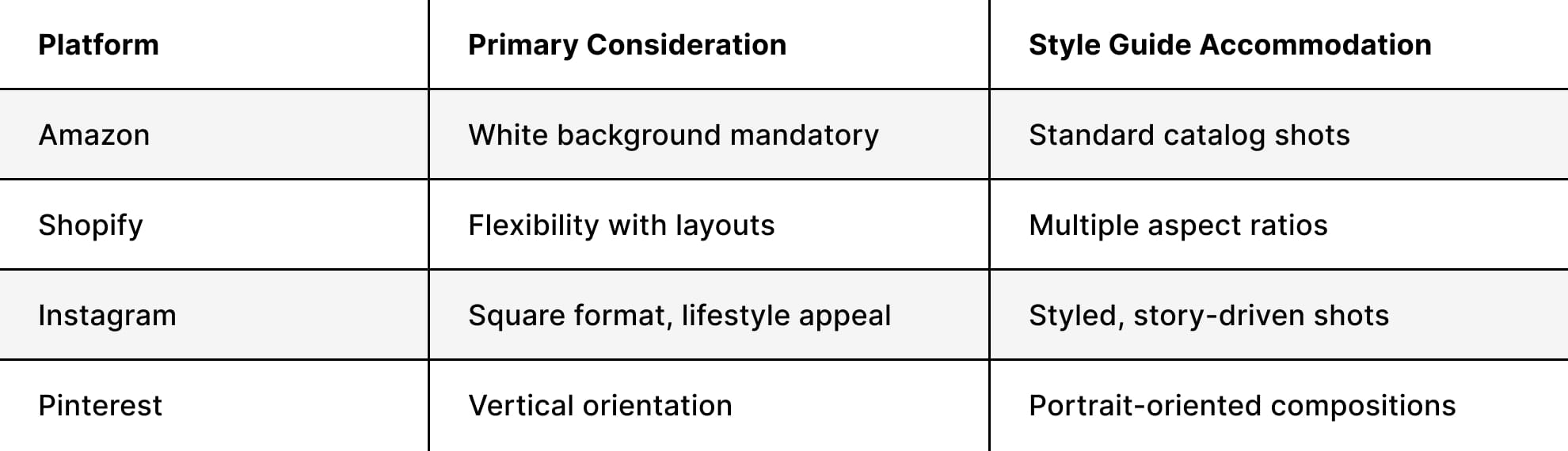
Understanding Amazon product image requirements versus Shopify specifications helps you plan shoots that serve multiple purposes efficiently. Shoot your primary angle for Amazon, then capture lifestyle variations for owned channels during the same session.
Seasonal and Campaign Variations
Your core brand standards remain constant, but seasonal campaigns might require temporary style variations. Document these exceptions clearly so they don't become permanent deviations.
Seasonal adaptations might include:
- Holiday-specific prop colors or themes
- Summer/winter lighting adjustments for mood
- Sale or promotion-specific product styling elements
- Collaboration or limited edition special treatments
The key is to treat these as documented variations rather than abandoning your product photography style guide entirely. When the season ends, everyone knows to return to baseline standards.
Category-Specific Standards
Different product categories often need different photographic approaches within your overall brand system. A comprehensive style guide acknowledges these variations while maintaining visual family resemblance.
For instance, creative eyewear photography requires different techniques than handbag photography, even though both might use similar backgrounds and color palettes. Document category-specific standards that work within your broader framework.
Maintaining and Evolving Your Style Guide
Your product photography style guide is a living document that should evolve as your brand grows, technologies improve, and market expectations change. The goal isn't rigid adherence to outdated standards but rather maintaining intentional consistency as you adapt.
Regular Review Cycles
Schedule quarterly or biannual reviews of your entire style guide. Gather stakeholders from photography, marketing, e-commerce, and creative teams to assess what's working and what needs updating.
Review these elements systematically:
- Technical specs (are they still current with available technology?)
- Visual examples (do they still represent your brand accurately?)
- Channel requirements (have platform specifications changed?)
- Competitive positioning (how does your photography compare to competitors?)
- Performance metrics (which image styles drive the best conversion rates?)
Use data from your product image optimization efforts to inform updates. If certain styling choices consistently outperform others, evolve your standards to incorporate those learnings.
Documenting Changes and Versioning
When you update your product photography style guide, track changes carefully. Version control ensures everyone knows which standards to follow and helps you understand how your visual identity has evolved.
Maintain a change log that records:
- Date of update
- Sections modified
- Reason for change
- Effective date (immediate vs. next shooting cycle)
- Archived previous versions for reference
This documentation proves invaluable when onboarding new team members or explaining brand evolution to stakeholders. You can point to specific decisions and show the thinking behind them.
Staying Current with Industry Trends
Product photography evolves constantly. While your brand identity should remain recognizable, your technical approach can incorporate new techniques that enhance rather than undermine consistency.
Monitor these trend areas:
- Lighting innovations (new modifiers, LED advancements)
- Styling approaches (creative product styling ideas that align with your brand)
- Post-processing techniques (AI-assisted retouching, batch processing improvements)
- Presentation formats (360-degree views, video integration)
- Sustainability considerations (digital sets, virtual photography)
The question isn't whether to adopt new techniques, but how to integrate them while maintaining your established brand identity. Your product photography style guide should enable innovation within a consistent framework.
Balancing Consistency with Creativity
Here's the tension every brand faces: you want consistent imagery, but you also need creative freedom to stay fresh and compelling. A well-designed product photography style guide creates guardrails, not prison walls.
Enable creativity by:
- Defining non-negotiable elements (these never change)
- Specifying flexible elements (these can vary within parameters)
- Encouraging experimental shoots (testing new approaches before updating standards)
- Creating special project exceptions (with clear documentation of why)
Some brands solve this by maintaining strict standards for catalog photography while allowing more freedom in creative campaigns and lifestyle content. The key is being intentional about when and why you deviate from your baseline standards.
Whether you're photographing your first products or optimizing an established catalog, Squareshot delivers the expertise and attention to detail that brings your style guide to life, ensuring every image reinforces your brand's unique visual identity while meeting the technical demands of modern e-commerce.
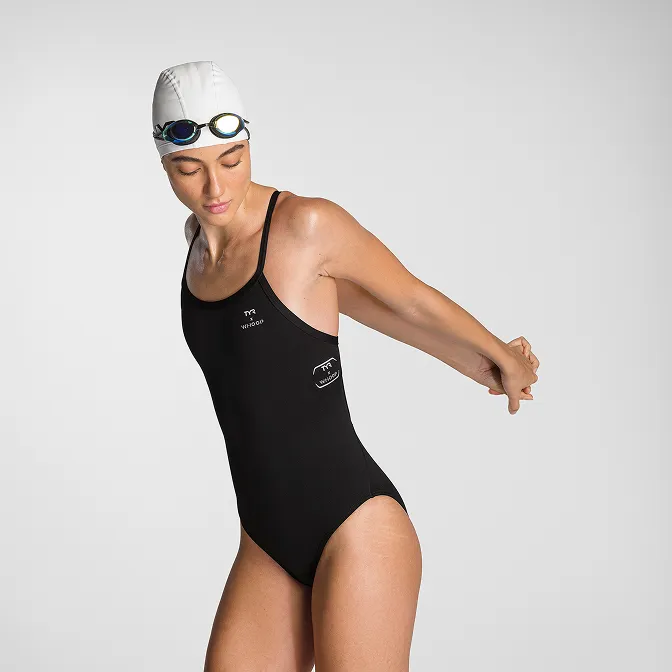
Product A
SQUARE SHOT