
The volume demands of modern e-commerce have outpaced what traditional photography workflows can handle alone. Brands now need hundreds of images across multiple platforms, contexts, and variations, and they need them fast.
That's where an AI product mockup generator changes the equation. Instead of committing to a full production shoot before you've validated the concept, you can visualize products across scenarios, test ideas quickly, and make smarter decisions about where your photography budget actually goes.
Understanding AI Product Mockup Generation Technology
AI product mockup generators use machine learning to create photorealistic product visuals without physical samples or a studio setup. The technology analyzes your product design, reads its dimensions and materials, and maps it across backgrounds, templates, and contexts automatically.
The gap between AI-generated and studio-shot imagery has closed fast. Early tools produced obvious composites: flat lighting, mismatched shadows, and textures that didn't hold up at zoom. Today's systems run on diffusion models and neural rendering, and in the right applications, the results are hard to distinguish from a professional shoot.
How AI Mockup Generators Work
The process typically involves three core components:
- Image recognition that understands your product's shape, texture, and proportions
- 3D rendering engines that map designs onto virtual surfaces with accurate perspective
- Neural networks trained on millions of product photographs to ensure realistic lighting and shadows
When you upload a product design, the system analyzes it and applies sophisticated algorithms to wrap it around target surfaces. The sketch-based and semantic-based modalities for mockup generation research demonstrates how different input methods affect output quality and workflow efficiency.
Modern platforms now offer features that were impossible just two years ago. Real-time previews, batch processing for multiple variants, and contextual scene generation have become standard capabilities.
Key Benefits for Product Marketing Teams
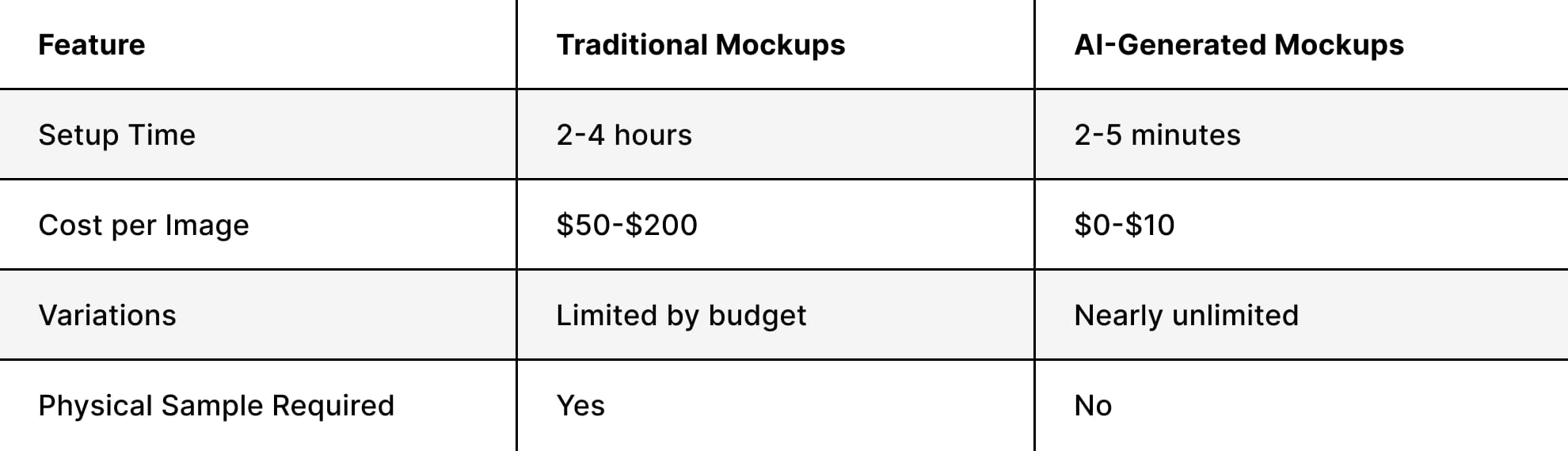
Speed is the most immediate advantage. A mockup generator produces dozens of variations in the time it takes to set up a single traditional shoot. That's not an incremental improvement. It changes how brands plan visual content from the ground up.
The budget case is just as strong. Professional product photography remains essential for hero images and key marketing materials. However, AI mockups enable teams to explore and validate concepts before any financial commitment is made. That means:
- Testing product designs before manufacturing
- Creating seasonal variations without reshooting
- Generating platform-specific imagery for different marketplaces
- Visualizing products in contexts that would be expensive to photograph traditionally
It also levels the playing field. A startup launching a new apparel line can generate hundreds of mockups showing different colorways, all before ordering a single sample, and show up visually on par with brands spending ten times more on content production.
Creative Testing and Iteration
Marketing teams use these generators for rapid A/B testing. You can create five different background variations, test them with your audience, and then invest in professional photography for the winning concept. This data-driven approach significantly reduces creative risk.
The human-centered AI product prototyping framework explores how no-code tools enable faster iteration cycles, which directly applies to mockup generation workflows.
Popular AI Mockup Generator Platforms
The market has exploded with options, each offering different strengths. MockingBird AI's free mockup generator provides quick results for e-commerce sellers, particularly those on Etsy and Shopify platforms.
For users seeking instant results across multiple product types, Media.io's AI mockup generator supports everything from t-shirts to phone cases with realistic rendering.
Specialized tools like Lovart's AI generator focus on creating photorealistic product images in different settings, packaging mockups, and a full suite of marketing materials, all aligned to your brand identity, without a physical shoot.
Comparing Generator Capabilities
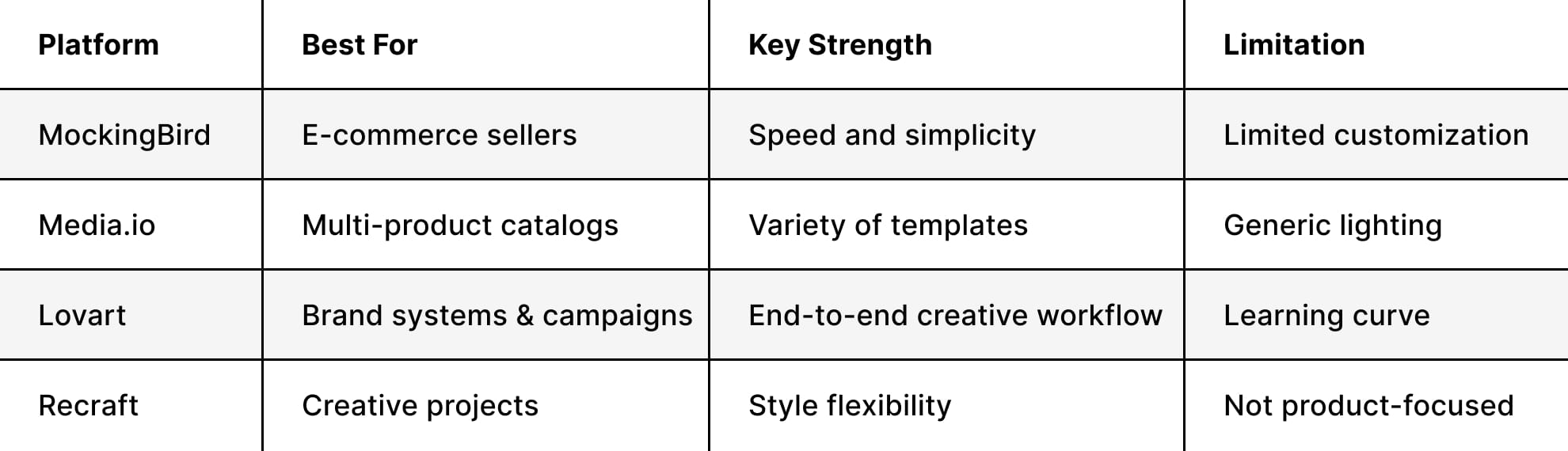
Many designers also explore Recraft as a free image generator for general creative work, though its mockup capabilities serve different purposes than dedicated product tools.
Integration with Professional Photography Workflows
Smart brands don't view AI mockup generators as replacements for professional photography. Instead, they integrate both approaches strategically. Use AI for exploration and volume, then invest in professional shoots for hero images and critical touchpoints.
This hybrid workflow makes perfect sense when you consider platform requirements. Amazon's product image requirements demand specific quality standards that AI might not consistently meet, while secondary lifestyle images could potentially use AI-generated backgrounds.
Strategic Workflow Design
Start your product launch with AI-generated mockups to test concepts internally. Once you've validated your direction, schedule professional photography sessions for primary images. Then use AI generators to create variations, seasonal updates, and platform-specific adaptations.
Professional studios like Squareshot's AI services now offer hybrid solutions that combine traditional photography expertise with AI enhancement capabilities, giving clients the best of both approaches.


The relationship between lifestyle shots and white background imagery becomes more nuanced when AI enters the equation. White background shots typically require professional precision, while lifestyle contexts offer more flexibility for AI experimentation.
Best Practices for AI-Generated Mockups
The tool is only as good as what you give it. AI mockup tools are only as good as the files you feed them. Start with high-resolution design files — vector formats where possible. They scale without quality loss and give the AI clean edges to work with.
Template selection matters more than most people treat it. A mockup built for Instagram needs a different composition than one built for Amazon's main image slot. Pick the template for the context, not just the aesthetic.
A few non-negotiables before you export:
- Export at platform-specific dimensions from the start
- Keep the lighting direction consistent across related images
- Lock in brand color accuracy through color profiles
- Test mockups at actual display size before signing off
Common Mistakes to Avoid
The biggest mistake brands make with AI mockups is using them everywhere, including places where they actively hurt you. Knowing where the tool breaks down is just as important as knowing what it can do.
Never use AI-generated visuals to misrepresent what you're actually shipping. If your mockup shows studio-grade presentation but the customer receives something that looks nothing like it, you've created a trust problem that no amount of good photography can fix.
The right tool for the right job isn't a complicated framework — it's just knowing when AI mockups serve the brief and when professional photography is the only honest option.
Industry-Specific Applications
Fashion and apparel brands were early adopters of AI mockup technology. The ability to show a shirt design in 20 different colors without manufacturing samples revolutionized pre-sale testing. Creative product styling ideas can be prototyped rapidly before committing to full production.
Home goods brands get a lot of mileage from AI mockups. A single candle can appear in a modern bathroom, a traditional living room, and a minimalist bedroom without three separate shoots. Context variety at a fraction of the cost.
Electronics is a different story. AI handles basic product placement well enough, but technical products demand a level of detail — port placement, screen quality, finish accuracy — that current generators struggle to maintain consistently. For specs, quality verification, and anything a customer will scrutinize up close, professional photography is still the only reliable option.
E-commerce Platform Considerations
Different platforms have different tolerances. On Shopify, mockups can work well for secondary images, supporting shots, lifestyle context, and variation swatches, while professional photography holds the primary slot. Knowing Shopify's image requirements helps you decide where AI fits without compromising the listing.
Amazon is stricter. Mockups might pass for variation images, but the main image is where you're competing directly against every other seller in the category. That slot needs professional quality. Amazon's photo standards set a bar that current AI tools aren't consistently clearing for hero images.
Technical Considerations and Limitations
Resolution is a real constraint. Most AI mockup generators output at standard web resolution. Print applications, large-format displays, and anything requiring deep zoom will expose the ceiling fast.
Lighting consistency is the other persistent problem. AI can simulate natural light and studio setups reasonably well, but matching the exact lighting across a large catalog requires precise parameter control that most tools don't make easy. For true consistency at scale, professional photography still has the edge.
Where current AI reliably falls short:
- Complex material textures like metallics and glass
- Accurate shadow casting from multiple light sources
- Product interaction with human models
- Extreme close-up detail preservation
- Brand-specific color matching across different materials
Quality Control Standards
Set quality benchmarks before anything goes live. Put your AI mockups next to your professional photography and assess honestly. Some categories will clear the bar; others won't. Your internal guidelines should reflect that difference, not paper over it.
For brands working in a minimalist visual style, AI generators can genuinely deliver. Clean backgrounds, simple compositions, and isolated product shots play to what these tools do well. Complex scenes with multiple products and detailed staging are a different matter. That's still professional photography territory.
Future Developments and Trends
The technology is moving fast. By late 2026, generators will start to understand brand guidelines and apply consistent styling across entire product lines automatically, something that required significant manual oversight even a year ago.
Real-time collaboration is emerging, too. Design teams can now iterate on mockups together, with AI suggesting variations based on performance data from previous campaigns. The feedback loop between analytics and creative output is getting tighter.
Video is the next frontier. Early systems can already generate simple product rotation videos from still images. As the technology matures, brands will produce product videos without traditional videography equipment, the same shift that happened with static imagery, playing out one format later.
Measuring ROI and Performance
Don't assume AI mockups are working. Measure it. Conversion rate comparisons between AI-generated images and professional photography give you the most direct read on performance.
Cost per image is straightforward to calculate. Take your subscription cost, add time investment and any editing required, then compare against professional photography quotes for equivalent volume. The number might surprise you in either direction.
Other metrics worth tracking:
- Time saved in creative iteration cycles
- Reduction in sample production costs
- Increase in testable design variations
- Improvement in time-to-market for new products
- Changes in customer engagement metrics
A/B testing cuts through the guesswork. Show segment A professional photos and segment B, AI mockups for the same product. Compare click-through rates, time on page, and conversion. Let the data tell you where each approach earns its place.
The essential guide to shoppable product images explains how different image types drive different customer behaviors, helping you deploy AI mockups strategically rather than universally.
Content Production at Scale
Large catalogs are where AI mockups make the strongest case. A brand selling customizable products in 50 colors and 10 styles has 500 potential combinations. Professional photography for every variant isn't realistic. AI handles that volume without slowing down.
Seasonal updates are the same story. Refresh your entire product line for the holidays, then revert, without reshooting anything. That kind of flexibility makes marketing more responsive and a lot cheaper.
E-commerce image standards still apply at scale. Not every image needs the same investment level, but all of them need to clear your brand's minimum bar.
Batch Processing Workflows
Stop generating mockups one at a time. Most platforms now support CSV uploads with product data, letting you generate hundreds of mockups from a single file. Set it up once, run the whole category.
Batch processing also improves consistency. The AI applies identical parameters across every item, creating visual coherence that's genuinely hard to replicate when products are shot individually over weeks or months.
Balancing Speed and Quality
Fast and cheap is a tempting default. It's also how premium brands quietly erode their positioning. The question isn't whether AI mockups are good enough in isolation. It's whether they're right for where and how your brand shows up.
Context decides. Internal presentations, supplier decks, and early concept testing don't need professional photography. Customer-facing listings, ad campaigns, and brand storytelling usually do. The investment is justified when the stakes are high enough.
The practical approach: use professional photography for hero images and critical touchpoints, then extend those shoots with AI-generated variations for secondary applications. You get the quality where it counts and the volume where you need it.
The photography for marketing guide frames it well: every image should serve a specific purpose in the customer journey. Apply that same logic to every AI versus professional photography decision you make.
Final Words
AI mockup generators have earned their place in a modern visual content workflow. They're genuinely useful for rapid iteration, concept testing, and high-volume variation work. But they work best alongside professional photography, not instead of it.
When your hero images, campaign assets, and brand-defining visuals need to be right, Squareshot provides the photography quality, retouching, and production support that turns product visuals into sales.
Product A
SQUARE SHOT