

AI catalog photography is no longer a niche capability. It's a production infrastructure decision that e-commerce brands are making at scale.
The core of these systems is straightforward: machine learning handles the repetitive, high-volume work — background removal, color correction, format compliance, batch processing — while your team focuses on what requires human judgment. The result is a catalog pipeline that moves faster, costs less per asset, and holds consistency across hundreds or thousands of SKUs without manual oversight at every step.
For brands where catalog size and time-to-market are operational constraints, that's not a minor efficiency gain. It's a structural advantage.
Understanding AI Catalog Photography Systems
An AI catalog photography system combines hardware, software, and machine learning to automate the most time-intensive parts of catalog production — from initial capture through post-processing, file organization, and delivery.
Where these systems earn their budget is on repetitive, high-volume work. Background removal, color correction, shadow enhancement, perspective adjustment — tasks that traditionally consumed hours of editor time now run automatically, at scale, with consistent output across entire product lines. The system analyzes product characteristics, identifies what each image needs, and applies the same parameters whether you're processing 10 SKUs or 10,000.
Core Components of AI Photography Systems
A production-ready AI catalog system typically includes:
- Intelligent capture stations with automated lighting adjustment
- Machine learning algorithms for image enhancement and quality control
- Asset management platforms with AI-powered organization and tagging
- Batch processing engines built for high-volume editing
- Computer vision-based quality assurance
These components don't operate independently — they form a connected pipeline that reduces manual touchpoints at every stage. The goal isn't to remove human judgment from the process. It's to reserve that judgment for decisions that actually require it, and automate everything else.
Workflow Efficiency and Cost Advantages
Traditional catalog photography is a coordination problem as much as a creative one. Photographers, stylists, editors, and production managers all have to move in sequence — and every handoff adds time. Each product needs setup, multiple angles, and a full post-production pass before it's ready to publish.
AI catalog systems compress that timeline at every stage. Processing that once took days runs in hours. Hundreds of images move through enhancement, formatting, and platform preparation simultaneously, without a queue building up between steps. For brands launching seasonal collections or reacting to market shifts, that speed isn't a convenience — it's a competitive variable.
The cost structure changes, too. Less labor per asset. Fewer revision cycles. Less reshooting caused by inconsistent output. The savings compound quickly at volume, and the per-image cost drops as the catalog grows — the opposite of what happens with traditional production.
Comparing Traditional vs. AI-Powered Workflows
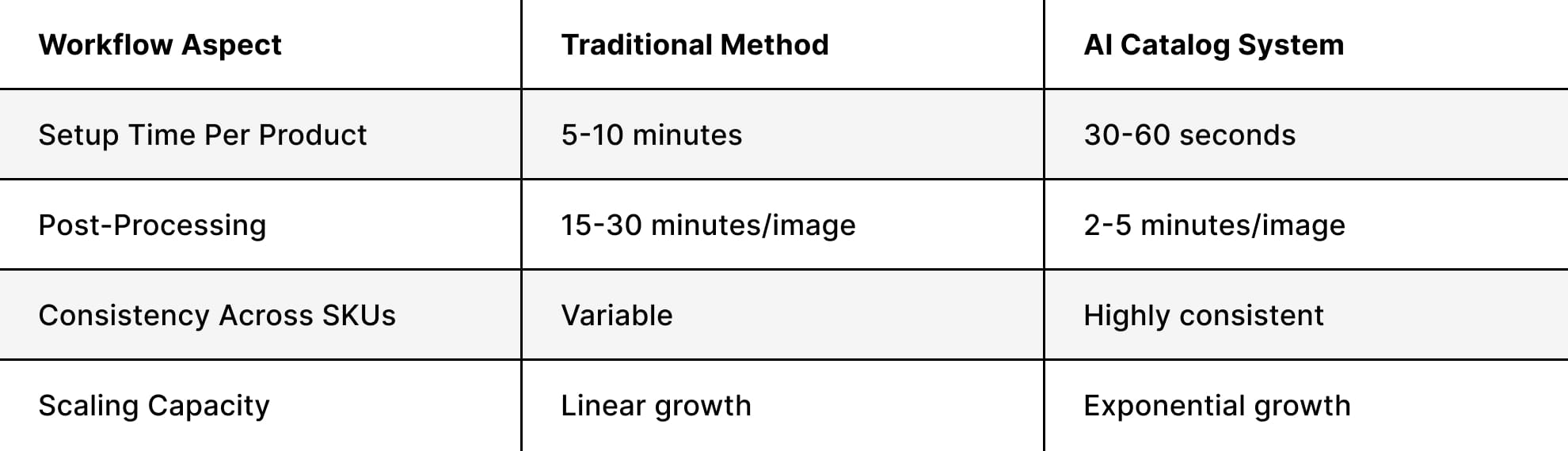
The financial implications extend beyond direct labor savings. Businesses reduce studio rental costs, minimize equipment needs, and eliminate the expenses associated with reshoots caused by inconsistent lighting or styling. As explored in our guide on scaling product photography with AI, these systems enable brands to maintain professional image quality while expanding their product catalogs.
Understanding e-commerce image standards becomes crucial when implementing AI systems, as these technologies must produce outputs that meet platform-specific requirements automatically.
Quality Control and Consistency Management
Consistency is one of the hardest things to maintain at catalog scale. Lighting shifts between sessions, editing decisions vary between editors, and the cumulative effect across thousands of SKUs is a catalog that looks like it came from three different brands. That inconsistency has a direct cost — it undermines the purchase confidence you're trying to build.
AI catalog systems solve this at the processing level. Every image runs through the same standardized parameters. Computer vision algorithms check each output against predefined quality benchmarks — focus, white balance, lighting adequacy, background cleanliness — and flag issues before anything enters the catalog. Problems get caught automatically, not during a manual review three steps later.
The practical result is a lower error rate, fewer images cycling back for correction, and a catalog that holds visual coherence whether you're looking at page one or page fifty.
Maintaining Brand Standards at Scale
AI systems learn from your existing brand guidelines and photography standards. Once trained, they apply these parameters consistently across all new product images. This includes:
- Color accuracy matching brand palette specifications
- Composition rules following established framing guidelines
- Lighting consistency replicating approved studio setups
- Background uniformity ensuring seamless catalog presentation
- Detail preservation maintaining sharpness in critical product features
The importance of product photography consistency cannot be overstated, as it directly impacts customer trust and conversion rates. AI systems excel at this repeatability, applying identical processing to similar products automatically.
Platforms like VizIQ demonstrate how AI-driven solutions can generate and optimize product visuals while maintaining strict brand standards across diverse product categories.
Integration with Existing Photography Operations
Adopting an AI catalog photography system doesn't mean rebuilding your operation from scratch. The most effective implementations don't replace existing photography workflows — they slot into them, handling the work that doesn't require creative judgment so photographers can focus on the work that does.
The division is straightforward in practice. Photographers handle hero images, lifestyle content, and campaign work — the shots where creative direction, product knowledge, and visual storytelling matter. AI systems handle standard catalog views, size variations, and color options — the work that needs to be consistent, fast, and scalable. Neither replaces the other. They run in parallel.
This is where the efficiency gains are most significant. The essential product photography workflow still depends on human judgment for creative decisions — how a product is lit, styled, and framed to communicate its value. AI handles the technical execution and volume processing that follows. That's not a compromise. It's the current best practice for studios and brands operating at scale.
Implementation Strategies for Different Business Sizes
The right entry point depends on your current volume and where the biggest bottlenecks are.
Small businesses typically start with AI-powered editing tools layered onto existing manual capture processes — background removal, batch color correction, and format resizing. Low upfront cost, immediate time savings, and no infrastructure overhaul required.
Mid-sized operations can move into semi-automated systems that handle more of the pipeline: consistent lighting setups, automated adjustments, streamlined post-production. The investment is higher, but so is the volume it's designed to support.
Enterprise brands running high-SKU catalogs often deploy fully integrated systems — robotic capture stations, automated processing pipelines, computer vision quality control — where human intervention is the exception rather than the rule.
When budgeting for e-commerce photography, the calculation isn't just the upfront system cost. It's upfront cost against long-term reduction in labor, reshoots, and revision cycles. For high-volume operations, the return typically materializes within 6 to 12 months.
Platform-Specific Optimization and Delivery
Every platform has its own image requirements — dimensions, file formats, background specs, and resolution minimums. Managing those variations manually across a large catalog is exactly the kind of low-judgment, high-repetition work that creates bottlenecks and errors.
AI catalog systems handle this automatically. A single master image becomes the source for every required output: Amazon-compliant white background shots, Instagram-optimized squares, high-resolution files for print. The system applies the right specifications for each destination without a separate manual pass. Understanding Amazon product image requirements upfront allows those parameters to be built directly into the processing pipeline, so compliance isn't a final check — it's built in from the start.
Platforms like Scatto demonstrate how far this has developed — generating both studio and lifestyle image variations optimized for different channels from a single input. Cataloger AI takes it further, combining visual processing with automated product description generation in the same workflow.
Squareshot's AI service approaches this differently: the product is always photographed physically, while AI handles models, scenes, and backgrounds — with every output manually refined by the post-production team before delivery. It's a hybrid model that keeps the product accurate and brand-safe while delivering campaign-ready visuals up to 7x faster than traditional product photography shoots. The direction across all of these is the same: less manual reformatting, more output from the same source material, across every channel simultaneously.


Automated Image Variant Generation
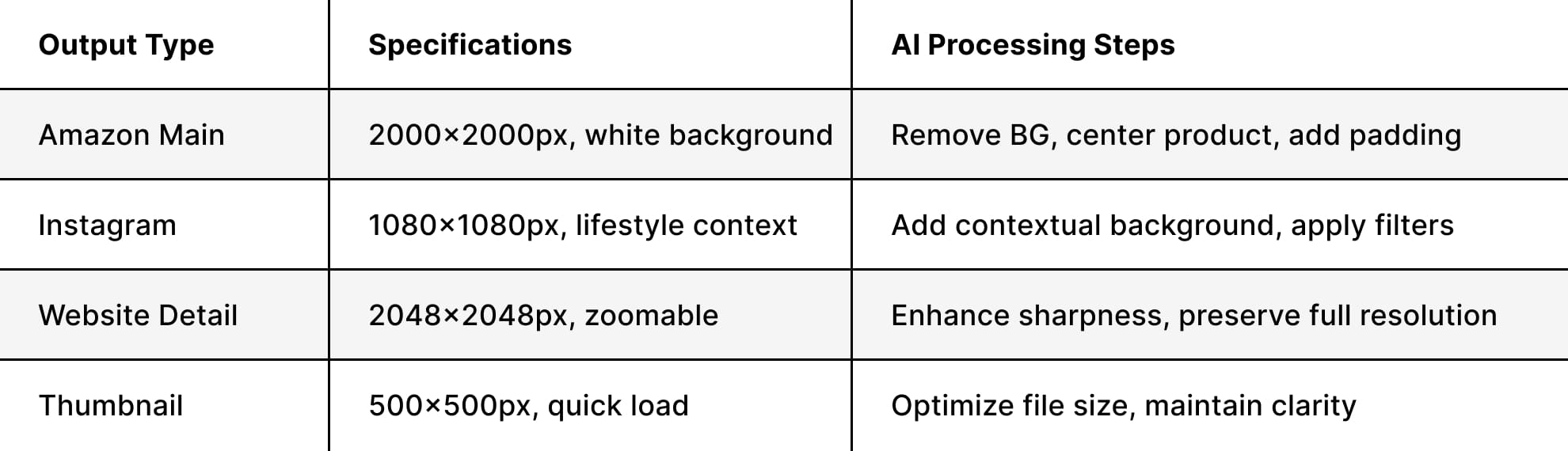
The system maintains a master high-resolution file while generating these variants on demand, ensuring consistency across all customer touchpoints. For brands selling on Shopify, understanding Shopify product image requirements ensures AI systems produce compliant outputs automatically.
Advanced AI Capabilities and Future Developments
The current generation of AI catalog systems does more than process existing images. Generative AI capabilities now enable these tools to create product views that were never physically captured: new angles, contextual environments, and lifestyle scenes constructed from limited source material."
Background generation is where this is most immediately practical. A product shot on white becomes a watch on marble, jewelry against velvet, or a skincare product on a bathroom shelf — without a stylist, a set, or a reshoot. The system builds the context around the product rather than requiring you to photograph the product inside it.
The more significant development is predictive presentation. Newer systems can analyze market data to recommend which visual treatments are most likely to perform — before you commit to producing them. That moves AI from a production tool into something closer to a strategic one.
The current ceiling is artifact quality. Research on AI-generated image artifacts offers useful grounding on how to identify synthetic photographs and where generation still breaks down — particularly around fine material detail, complex reflections, and product accuracy at close range. These are real limitations that matter for commercial output, and understanding them is part of making responsible decisions about where AI belongs in your pipeline.
As the technology matures, the gap between traditionally photographed and AI-generated images continues to narrow. The brands that understand both the current capabilities and the current limits will be better positioned to use these tools effectively — and to know when not to.
Emerging Technologies in 2026
- 3D model extraction from 2D product photos
- Augmented reality integration for virtual try-on experiences
- Predictive analytics for optimal image performance
- Neural rendering for photorealistic product visualization
- Automated A/B testing of image variations
For specialized industries, fashion brands can leverage platforms like Katalane that offer AI-powered image matching and photoshoot capabilities tailored to apparel and accessories.
Managing Large-Scale Catalog Operations
At thousands of SKUs, catalog management stops being a creative problem and becomes an operational one. The volume of routine updates, seasonal refreshes, and new product launches exceeds what manual workflows can absorb without significant lag and error accumulation.
AI catalog systems are built for exactly this load. Automated scheduling tracks inventory changes and flags products requiring new or updated imagery before they become a customer-facing problem. When a seasonal variation arrives, or a colorway is added, the system queues it for processing without waiting for someone to notice the gap.
Color variation management is one of the clearest efficiency gains at scale. Traditional production requires a separate shoot for each colorway — multiplying time and cost linearly with catalog size. AI systems generate color variations from a single master image, producing realistic representations of each option without additional sessions. For a catalog with 200 base products across five colorways each, that difference is substantial.
Organizing and Retrieving Catalog Assets
AI-powered asset management changes how teams locate and use imagery once it exists. Natural language search lets users find images by description — "blue running shoe, white sole, lifestyle background" — rather than navigating folder hierarchies built around shoot dates or SKU codes. Tools like Excire Search 2026 show how this capability is already being integrated into standard post-production platforms like Lightroom Classic, making AI-assisted search accessible without a dedicated DAM system.
Version control becomes automated as well. Every iteration, edit, and approval state is tracked and retrievable — so when a brand needs to reference a previous product presentation, revert to an original file, or audit what changed between catalog cycles, that history is accessible without manual archiving or tribal knowledge about where files live.
Balancing Automation with Creative Excellence
Automation and creative quality aren't in opposition — they're in competition for the same resource: your team's time. The brands getting the most from AI catalog systems are the ones that have been deliberate about which work goes to automation and which stays with people.
Standard catalog views — consistent angles, white backgrounds, format compliance — are the right work for AI. It handles the volume, maintains the consistency, and frees up photography teams to focus on the work that actually requires judgment. That means more time spent on creative product photography that differentiates a brand rather than documents it.
The division isn't always obvious, and whether to use AI product images depends on the specific use case and what's at stake for each image type. Catalog documentation is generally well-suited to AI processing. Hero images, campaign work, and lifestyle photography, where the goal is emotional connection rather than product accuracy, typically benefit from a human directing every decision.
For categories where presentation is the product — home decor, for instance, where styling and context carry the purchase decision — AI handles technical execution while photographers focus on storytelling. The output improves when neither is asked to do the other's job.
Technical Considerations and System Requirements
Before committing to an AI catalog photography system, the infrastructure requirements deserve as much attention as the software capabilities. High-resolution image processing at volume is computationally demanding — and the gap between what a system can do in a demo and what it can sustain at daily production scale is where most implementation problems originate.
Cloud-based solutions address this directly. They scale with volume rather than requiring fixed on-premise capacity, and they update automatically as underlying AI models improve — which matters in a space where the technology is still developing quickly. For most brands, cloud infrastructure is the practical default unless data residency requirements dictate otherwise.
Data security is a real consideration, not a checkbox. Catalogs containing unreleased products or proprietary designs represent meaningful IP exposure. Any system handling that material needs access controls, encryption, and audit trails that track who accessed what and when. Evaluate this before implementation, not after.
Building a Reliable Technology Stack
A production-ready AI catalog system typically requires:
- Capture equipment compatible with automation systems
- High-speed storage for raw image archives
- Processing infrastructure with GPU acceleration
- Asset management platform with AI integration
- Quality control interfaces for human review
- Distribution connections to sales channels and e-commerce platforms
Integration with existing tools is where implementation either succeeds or stalls. An AI system that operates in isolation from inventory management, your e-commerce platform, and marketing workflows creates new coordination overhead instead of reducing it. The systems worth investing in connect to what you already use. Reviewing the best AI tools for product photos is a useful starting point for identifying solutions that fit your specific technical environment.
Training AI Systems on Brand Guidelines
An AI catalog system doesn't arrive at understanding your brand. That understanding has to be built through approved examples, defined parameters, and enough training data for the system to recognize what good output looks like for your specific visual standards.
The quality of that training determines the quality of everything that follows. Brands with well-documented product photography standards move through this phase faster and with more reliable results. The more precisely your standards are defined before training begins, the less correction work happens after.
Training isn't a one-time event. As brand guidelines evolve, new product categories are added, or visual preferences shift, the system needs to be updated to reflect those changes. Treat it as ongoing calibration rather than a setup task you complete once and move on from.
Feedback Loops and Continuous Improvement
The most effective AI catalog systems get better through use. When editors make manual adjustments to AI-processed images, those corrections feed back into the system — and similar modifications get applied automatically to future outputs. Over time, the volume of manual intervention decreases as the system learns what your team consistently changes and why.
Performance metrics make this progress visible and defensible. Rejection rates, editing time per image, and revision cycles are the clearest indicators of whether the system is improving. Tracking these over time demonstrates tangible ROI — reduced cost per asset, faster delivery, fewer images cycling back for correction — and builds the internal case for continued investment.
The brands that get the most from AI catalog photography are the ones that treat it as a system to be managed, not a tool to be set up. The technology handles routine documentation at scale. The judgment about what's good enough, what needs correction, and where the system still falls short — that stays with your team.
Whether you're building out a growing e-commerce catalog or refreshing thousands of SKUs each season, Squareshot combines AI capabilities with experienced photographers and post-production oversight to deliver product imagery that meets commercial standards — without trading speed for quality.
Product A
SQUARE SHOT